
Sep 22, 2026
Why Choose ASTM A928 UNS S32750 Welded Steel Pipe for Marine Use?
When your project operates in seawater, brine, or aggressive offshore conditions, material selection is not a minor detail — it determines whether a system lasts two years or twenty. ASTM A928 UNS S32750 welded steel pipe is a super duplex stainless steel pipe engineered precisely for these conditions. With a Pitting Resistance Equivalent Number (PREN) above 42, it withstands chloride attack, stress corrosion cracking, and high-pressure service that would degrade standard austenitic grades within months. From desalination plants to offshore platforms, this pipe grade has earned its place as one of the most trusted materials in marine piping systems.
|
|
|
Understanding ASTM A928 UNS S32750 Welded Steel Pipe
Chemical Composition That Drives Performance
About 25% of UNS S32750, which is also known as Super Duplex 2507, is chromium, 7% is nickel, 4% is molybdenum, and 0.28% is nitrogen. This specific chemistry creates a balanced ferrite-austenite microstructure that is about 50/50. This is what makes it strong in both chemical and mechanical ways. Its PREN is well above 40, which is a known limit for seawater service, because it has a lot of molybdenum and nitrogen in it.
Mechanical Properties and Dimensional Range
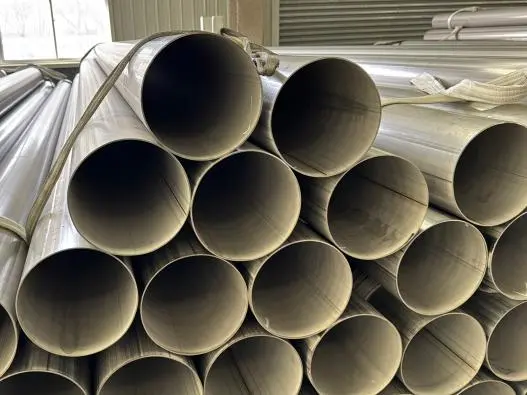
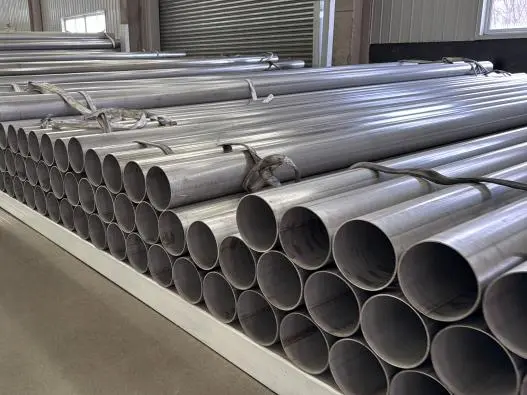
The Electric Fusion Welded (EFW) process is used by YOUFA to make this grade. The microstructure is then stabilized by solution annealing and water quenching. Outside sizes of pipes range from 114.3 mm to 2500 mm, and wall thicknesses range from 3 mm to 50 mm. The yield strength is at least 550 MPa, and the tensile strength is over 800 MPa. This is about twice as strong as normal 316L stainless steel.
Welding, Heat Treatment, and Documentation
For duplex stainless steel, the right heat treatment after welding is a must. The balance between ferrite and austenite is restored by solution annealing, and the risk of sigma phase embrittlement is removed. YOUFA provides full records, like MTC/MTR (3.1/3.2), WPS/PQR, UT/RT reports, and hydraulic test records, so buying teams can follow the raw material all the way to the finished pipe.
Core Advantages of UNS S32750 Pipes in Marine Environments
Pipes in marine settings have to deal with some of the roughest conditions in industrial service. ASTM A928 UNS S32750 Welded Steel pipe changes in temperature, chloride levels, and mechanical stress all happen at the same time on pipe walls, joints, and welds. The main reasons why S32750 is the best choice for these uses are its better performance:
- Chloride corrosion resistance: S32750 resists pitting and crevice corrosion in seawater at temperatures up to 50°C, confirmed through ASTM G48 Method A ferric chloride testing. Standard 316L stainless steel begins to pit at chloride concentrations above 200 ppm; S32750 performs reliably at concentrations several times higher.
- Stress corrosion cracking (SCC) immunity: The duplex microstructure significantly reduces SCC susceptibility compared to fully austenitic grades, making it suitable for high-pressure marine pipelines subject to cyclic loading.
- High mechanical strength with weight efficiency: With yield strength near 550 MPa, engineers can specify thinner walls for the same pressure rating, reducing overall system weight — a real advantage in offshore platform design.
Because of these benefits, there is less need for inspections, less downtime, and longer replacement cycles. These are all things that affect the total lifecycle cost, which is higher than the initial purchase price.
Compared to seamless pipes, EFW welded pipes have shorter lead times and a wider range of sizes available, especially for lengths above 600 mm, where seamless production isn't practical. This is important for marine infrastructure projects that need to be finished quickly.
Comparing UNS S32750 with Alternative Alloys for Marine Use
S32750 vs. 316L Stainless Steel
316L is often used in mildly acidic conditions and costs less at first. But its PREN of about 24 is not even close to what ocean service needs. In coastal settings, 316L has been known to have problems like chloride-induced pitting, SCC failures, and faster weld zone degradation. Replacement and repair costs often go over the initial savings over the course of a 10-year project's lifecycle.
S32750 vs. Duplex 2205 (UNS S32205)
The middle ground of cost-effectiveness, Duplex 2205 has a PREN of 35–38 and is good for brackish water and moderately aggressive chemical service. The higher alloy content in S32750 makes it more resistant to full immersion in seawater or high-temperature brine. YOUFA offers both grades, 2205 and 2507, so buying teams can match materials to real-world service conditions instead of defining too much or too little.
Pricing, Lead Times, and Supply Chain Factors
The higher nickel and molybdenum content of S32750 makes it more expensive than 2205 and 316L. YOUFA's MOQ, on the other hand, is just one pipe, and the quickest transport gets to Tianjin Port in seven days. This adaptability helps with both big offshore projects and smaller upkeep jobs, without making it necessary to keep more supplies than is needed.
Procurement Guide: How to Source UNS S32750 Welded Pipes?
Evaluating Certified Manufacturers
When looking for super duplex stainless steel pipe, the first thing you should look at is the certifications. ASTM A928 UNS S32750 Welded Steel pipe checks to see if the company has an ISO 9001 quality management system, pressure equipment that meets PED standards, TÜV certification, and an ISO 17025-accredited testing lab that is located on-site. YOUFA has all of these approvals and runs 15 production lines that make 50,000 tons of goods every year, making it one of China's Top 500 companies.
Quality Control Checkpoints
For marine-grade pipe, it is normal to do very thorough inspections. Important tests are:
- Hydrostatic testing: Mandatory for every pipe to confirm pressure containment integrity.
- Radiographic or ultrasonic examination (RT/UT): Full weld seam inspection per ASTM A928 class requirements.
- Mechanical and chemical testing: Verification of tensile strength, impact toughness (Charpy V-notch), and alloy composition.
- Microstructural analysis: Ferrite-austenite ratio quantification to prevent sigma phase formation that would compromise toughness.
Ordering, Logistics, and Documentation
YOUFA sells pipes in random or set lengths, with either a pickled or an annealed finish on the outside, and with either a straight or a curved end. For shipping by sea, wooden boxes with possible steel frames are used, along with hexagonal binding and woven bags to protect the goods. The full set of export papers needed for most foreign projects is available, including MTC/MTR, TPI, WPS/PQR, MPS, and UT/RT reports.
Real-World Applications in the Marine Industry
Offshore Platforms and Subsea Pipelines
In North Sea and Gulf of Mexico offshore projects, S32750 pipes have been used instead of 316L pipes in lines that inject seawater and cool it down. This has cut down on shutdowns caused by corrosion by a noticeable amount. These lines are useful for both above- and below-ground applications because they are strong and don't react with chlorides.
Desalination Plants
Desalination uses very concentrated brine at very high temperatures, which is one of the roughest places to work in industrial processes. Super duplex stainless steel pipe is now the standard for high-pressure feed lines and concentrate output in reverse osmosis plants in the Middle East and North Africa. This is because 316L and even duplex 2205 had high failure rates for these parts.
Shipbuilding and Port Infrastructure
More and more, S32750 is being used for vital parts in seawater cooling systems, ballast water treatment lines, and fire suppression networks on big ships. Because it can be welded (as long as the right WPS/PQR steps are taken), it can be made quickly in the port without the risk of rust that comes after welding that comes with other alloys.
Conclusion
Marine work calls for things that do their job perfectly. Standard stainless grades just can't compete with UNS S32750 welded pipe made to ASTM A928 UNS S32750 Welded Steel pipe when it comes to corrosion protection, mechanical strength, and proven dependability in saltwater or brine conditions. This grade is a good technical and financial choice for procurement teams in charge of offshore, desalination, or shipbuilding projects when looked at over the whole project lifecycle.
FAQ
What makes UNS S32750 suitable for marine environments?
With a PREN above 42, UNS S32750 is a super duplex stainless steel that is one of the best corrosion-resistant alloys for use in salt water. Its balanced ferrite-austenite microstructure stops chloride pitting, crevice corrosion, and stress corrosion cracking, which are the three main ways that marine piping systems fail.
What is the difference between ASTM A928 and ASTM A312 for this grade?
For general acidic service, ASTM A928 covers electric fusion-welded austenitic and duplex stainless steel pipe. It has specific rules for the weld inspection class and the heat treatment. Austenitic grades that are seamless and welded are covered by ASTM A312. While in naval service, A928 is the standard that applies to large-diameter bidirectional pipe.
Can UNS S32750 pipes be customized for specific project dimensions?
Yes. YOUFA makes pipes with ends that are 114.3 mm to 2500 mm wide and walls that are 3 mm to 50 mm thick. The lengths of these pipes can be set or chosen at random. End finishes, surface treatments, and paperwork packages can all be made to order to fit the needs of each job.
What welding practices are required to maintain pipe integrity?
Procedure qualification records (PQR) and welding procedure specs (WPS) must be made and followed to the letter. Solution annealing and water cooling after the weld fix the microstructure. Avoiding too much heat and interpass temperatures above 150°C stops the formation of the sigma phase and keeps the toughness.
Partner with YOUFA for Your Next Marine Piping Project
Youfa Stainless Steel Pipe Co., Ltd. is known for making reliable ASTM A928 UNS S32750 Welded Steel pipes for clients in the chemical, marine, and offshore infrastructure sectors. YOUFA can help with projects of all sizes because it is certified to ISO 9001, PED, TÜV, and ISO 17025, can make 50,000 tons of pipes a year, and the minimum order quantity is just one pipe. Get in touch with our expert team right away to get mill test results, dimensional specs, or a price that is tailored to your project. You can email us at info@youfass.com or go to youfass.com.
Online Message