Oct 20, 2026
What Industries Use EN 10217-7 1.4301 Welded Pipes?
EN 10217-7 1.4301 Welded Stainless Steel Pipes are used across a broad range of industries that require pressure-rated piping with reliable corrosion resistance. The grade 1.4301 — equivalent to AISI 304 — is an austenitic chromium-nickel alloy that performs consistently in chemical processing, food and beverage production, power generation, HVAC systems, automotive manufacturing, and pharmaceutical fluid handling. Its compliance with the European Pressure Equipment Directive (PED) makes it a preferred choice for engineers and procurement professionals who need traceable, certified pipe materials for demanding service conditions.
|
|
|
Introduction to EN 10217-7 1.4301 Welded Stainless Steel Pipes
What the EN 10217-7 Standard Covers?
EN 10217-7 is a European standard that talks about welded circular stainless steel tubes that are meant to be used under pressure. It sets limits on the chemicals that can be used, their mechanical properties, size variations, and the testing methods that must be used. This rule applies to Grade 1.4301, which is an austenitic metal that has at least 18% chromium and 8% nickel. It can be pulled apart with 520 MPa of force and is very resistant to damaging conditions.
Welded vs. Seamless: Understanding the Production Difference
Flat stainless steel strip is made into a tube, and TIG or plasma arc welding is used to join the seams around the tube. If they are made according to EN 10217-7 standards, welded tubes can be made in smaller sizes and cost less to make than smooth pipes. They also make the body strong. The metal properties in the weld area are evened out by solution annealing. This makes sure that the pipe works the same way everyplace.
Key Material Advantages That Drive Adoption
A lot of people use grade 1.4301 because it doesn't corrode at high temperatures, it works well with many chemicals, and it's simple to shape when it's being made. Because of these traits, it can be used in systems that move fluids and need to keep pressure, not rust inside, and work well for years at a time. It's not good for places with a lot of chloride; grades like 1.4401 or 1.4404 are better there.
Key Industries Utilizing EN 10217-7 1.4301 Welded Pipes
There are more places than most people think to find grade 1.4301 waxed pipes that meet EN 10217-7. Here are the places where this pipe type regularly does well, in order of how much value they add:
Food, Beverage, and Pharmaceutical Processing
In these areas, EN 10217-7 1.4301 Welded Stainless Steel Pipes need to be made of materials that can handle organic acids, be cleaned often, and meet cleanliness standards set by the FDA and EHEDG. Welded pipes of grade 1.4301 are often used in systems that process milk, move drinks, and move fluids used in medicine. Since the surface has been pickled and annealed, microbes are less likely to stick to it. The smooth weld bead inside can be controlled or taken out to meet all CIP (Cleaning-in-Place) standards.
Chemical and Industrial Processing
In chemical plants that work with weak acids, bases, and process water, these pipes are used in heat exchangers, reactor inlet/outlet lines, and links between storage tanks. Many process chemicals can't hurt the alloy because it has a passive oxide layer on top of it. Buy engineers usually ask for 1.4401 (316) or 1.4571 from the same EN 10217-7 grade family for extra safety in places with chlorides or temperatures above 300°C.
Power Generation and HVAC Systems
These pipes are used in steam pipes, condensate return lines, and cooling water loops in power plants. The people who work in HVAC use them to link air handling units, move cold water, and create heated loops with pressure. The pipe's pressure grade under EN 10217-7 makes it good for systems where the fluid's temperature and pressure change a lot. Carbon steel, on the other hand, doesn't do well in these situations without a protective coating.
Comparative Insights: Why Choose EN 10217-7 1.4301 Pipes Over Alternatives?
1.4301 vs. 1.4401: When Does Grade Matter?
The grade 1.4301 can be used in places that are slightly acidic and don't use chlorine. When you add 2–3% molybdenum to Grade 1.4401 (316), it makes it much less likely to pit, especially in seawater or chloride-containing process fluids. Because it works well and costs less than molybdenum-bearing types, 1.4301 is a good choice for food-grade circuits, chemical dosing lines, and general industrial water systems.
Welded Pipes vs. Seamless Pipes Under EN Standards
There are rules for welded tubes (EN 10217-7) and rules for smooth steel tubes (EN 10216-5). It is just as safe to use welded pipes made to EN 10217-7 with confirmed WPS/PQR documentation and UT/RT non-destructive tests in most pressure uses as it is to use seamless pipes. Welded production keeps the same sizes, which makes it easier to fit flanges and put things together in the field.
Cost Efficiency Without Compromising Compliance
A big reason why procurement managers pick welded lines that meet EN 10217-7 standards is that they can be tracked. An MTC 3.1 or 3.2 mill test certificate, a Third-Party Inspection (TPI) report, and PED permission are all pieces of paper that projects need, especially in North American and European managed industries. When it comes to big jobs, certified welded pipes are a better deal than seamless pipes with the same thickness because they cost 20–40% less.
Procurement Guide for EN 10217-7 1.4301 Welded Stainless Steel Pipes
When you buy pressure-rated stainless pipe from an EN 10217-7 1.4301 Welded Stainless Steel Pipes supplier, it's important to look at the certification, the range of sizes, and the paperwork. Here are the main things that smart buying teams think about before making a choice.
Buyers should make sure of the following things before placing an order:
It comes in grades 1.4301, 1.4306, 1.4307, 1.4401, 1.4404, 1.4541, 1.4539, and 1.4571. Pick the grade that fits your needs the best.
The OD range is from 10.3 mm to 2500 mm, and the wall thickness is from 0.8 mm to 40 mm. Compare the size error to your design plans.
- Grade options: 1.4301 / 1.4306 / 1.4307 / 1.4401 / 1.4404 / 1.4541 / 1.4539 / 1.4571 — match the grade to your service conditions.
- OD range: 10.3 mm to 2500 mm; wall thickness from 0.8 mm to 40 mm — confirm dimensional tolerance against your design drawings.
- Delivery condition: Solution annealed with pickled and annealed surface finish as standard — critical for weld zone integrity.
- End finish: Plain end or beveled end available — specify based on your installation method.
- Documentation: MTC/MTR (3.1/3.2), TPI, WPS/PQR, MPS, UT/RT reports — these are non-negotiable for PED-regulated projects.
- MOQ and lead time: MOQ starts at 1 pipe; fastest delivery to Tianjin Port in 7 days for stocked sizes.
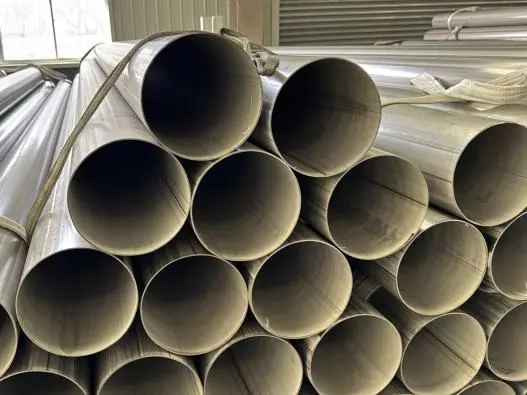
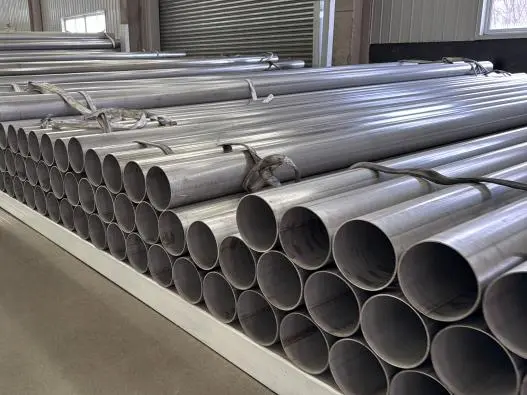
- Packaging: Wooden box with optional steel frame, hexagonal binding with woven bag — appropriate for sea freight and long-distance transport.
—No matter where you want to put it, you can pick an end finish that is either straight or bent.
Applications Case Studies Demonstrating EN 10217-7 1.4301 Pipe Effectiveness
Food Processing Plant: Hygienic Piping Upgrade
An animal feed factory moved from carbon steel pipes to welded pipes of grade 1.4301 to meet the new EHEDG safety design standards. After it was put in place, it was checked to make sure that the shape of the clean weld bead and the surface roughness were both good. In the 18 months that the facility was open, there were no reports of contaminated products. This is a big change from the last system, which often broke down because of rust.
Chemical Plant: Heat Exchanger Tube Replacement
New welded EN 10217-7 grade 1.4301 tubes were put in place of old copper-alloy tubes in a chemical plant that uses weak sulfuric acid. The source gave full MTC 3.1 papers and RT records for each weld seam. It took two years of running for the plant's repair team to see a 60% drop in the number of times tubes needed to be changed. They think this is because the metal can handle acid better than the copper-based material that was used before.
HVAC System: Pressurized Chilled Water Circuit
The chilled water delivery loop in a business building project near the coast used welded pipes of grade 1.4301. Ten bars of pressure are enough for the system to work. Records from rust checks after three years of use showed that there was no wall loss that could be seen. This showed that the material choice was good and set a bar for the next steps in the development group's work.
Conclusion
For pressure pipes used in HVAC, power systems, food processing, and chemical handling, EN 10217-7 1.4301 Welded Stainless Steel Pipes are a good choice that has been tested and shown to work. They are a good choice for most moderate-service settings because they don't rust, can be fully tracked according to EN standards, and don't cost too much. You can get grades like 1.4401 and 1.4404 as straight upgrades in the same EN 10217-7 family if you need more protection against chloride. Getting these pipes will be easy and safe if the buying team checks ahead of time to make sure they meet the size, approval, and material grade standards.
FAQ
What is the chemical composition of grade 1.4301?
Grade 1.4301 contains 17.5–19.5% chromium, 8–10.5% nickel, and a maximum of 0.07% carbon. This composition gives the alloy its passive oxide layer and resistance to atmospheric and mildly acidic corrosion. It is the European designation for what the American market calls AISI 304 stainless steel.
Are EN 10217-7 welded pipes suitable for high-pressure applications?
Yes, when produced and tested in compliance with EN 10217-7, these pipes carry valid pressure ratings for industrial service. The exact allowable pressure depends on pipe OD, wall thickness, operating temperature, and grade. All pressure calculations must reference the applicable standard and be verified against PED requirements for the specific installation.
What documents should I request when ordering?
At minimum, request MTC/MTR (3.1 or 3.2 as required), WPS/PQR records, and UT/RT non-destructive testing reports. For PED-regulated projects, TPI and manufacturer TÜV certification documentation are also standard requirements. These documents confirm weld integrity, material traceability, and compliance.
What is a typical lead time for custom-size orders?
For standard stocked dimensions, delivery to Tianjin Port is achievable in as few as 7 days. Custom dimensions — including non-standard ODs or wall thicknesses — typically require 3 to 6 weeks depending on order volume and production scheduling.
Get a Quote from YOUFA — Your EN 10217-7 1.4301 Welded Stainless Steel Pipes Manufacturer
Youra makes 50,000 tons of stainless steel pipe each year on 15 different lines. YOUFA is a company that makes EN 10217-7 1.4301 Welded Stainless Steel Pipes. They are TÜV-certified, ISO9001-compliant, and PED-compliant. With reports like MTC 3.1/3.2, TPI, and UT/RT, they give you all the information you need. One pipe is the smallest amount that can be ordered. Send an email to info@youfass.com or go to youfass.com right now to get more information or a quote on your project.
Online Message