Nov 4, 2026
EN 10217-7 1.4541 Stainless Steel Pipe for Fabricated Equipment and Long-Term High-Temperature Service
This EN 10217-7 1.4541 stainless steel pipe has been used for a long time and is always a good choice when engineers and buying teams talk about pipes for high-temperature machinery. It is the same as AISI 321 and is an austenitic grade with titanium stabilisation. It works well at temperatures up to 800°C, doesn't rust when welded, and meets the EN 10217-7 requirements for welded pipes. This pipe grade stays mechanically stable over a long period of time, which is great for building heating systems, exhaust units, or chemical handling equipment.
|
|
|
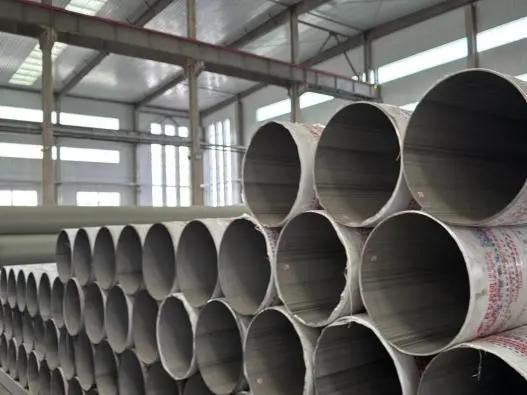

Understanding EN 10217-7 1.4541 Stainless Steel Pipe
Chemical Composition
Grade 1.4541 has between 17.0 and 19.0% chromium, 9.0 and 12.0% nickel, and up to 0.70% titanium that doesn't change when the temperature drops below 5 C. Titanium is added to this metal, which makes it unique. Because titanium binds carbon before chromium does, carbides don't form at the edges of grains when they are welded. Grades that aren't stabilised, like 304 or 1.4301, are much more likely to scratch.
Mechanical Properties
The yield strength (Rp0.2) of 1.4541 is about 205 MPa, and the tensile strength (Rm) is between 500 and 700 MPa. Most of the time, the length at break is 40% or more. That grade works well in places where pressure needs to be kept, like heat exchangers, boilers, and systems that move hot fluids. It will last a long time because it works well in hot places.
Heat Treatment and Delivery Condition
Most of the time, pipes that are made to EN 10217-7 are sent out in a state called "solution-annealed." When you melt the pipes, they won't rust again because the grain is evened out. Between 1050°C and 1120°C is where solution annealing takes place. After that, the material is quickly cooled down. That's what the standard says should be done to the pipe to make sure it meets the requirements for strength and rust resistance at the delivery spot.
Advantages and Comparative Analysis of 1.4541 Pipes
How 1.4541 Compares to Other Grades?
Grade 1.4541 stops intergranular rust better than normal 304 (1.4301) in places that have been heated. This is important for when the pipe is being joined in the field. It is more likely to pit in salt conditions than 316L (1.4404) because it doesn't have as much molybdenum (PREN for 1.4541 is about 18–20), but its titanium content makes it the best choice for heat service that goes through cycles.
It is important to understand these trade-offs correctly. This is how the following grades do in different kinds of service:
- 304 is cheaper, but it can be damaged by grain boundary attack in places that get hot and stay hot for a long time. 1.4541 stays strong after welding and doesn't become sensitised.
- As for 1.4541 vs. 316L (1.4404), 316L is better at resisting pitting in chloride-rich environments, but 1.4541 is better for high-temperature service cycles and exhaust systems where heat stress is the main concern.
- This is the same for both 1.4541 and 1.4571; however, 1.4571 has an extra 2 to 5% molybdenum, which gives it a PREN of about 23 to 26. Work with strong acids is better with 1.4571, but clean high-temperature work with 1.4541 costs less.
When choosing EN 10217-7 1.4541 Stainless Steel Pipe for service, these comparisons show that grade familiarity alone is not enough. The actual service environment should also be taken into account.
Welded vs. Seamless Pipes
Welded pipes made according to EN 10217-7 are tested to either Test Category TC1 or TC2. TC2 tests the weld seam lengthwise without damaging it (weld factor v = 1.0). Most of the time, welded 1.4541 pipe works just as well as seamless pipe in built-up areas that can be inspected properly. It also costs less, usually 15–25% less, based on the wall thickness and order number.
Procurement Guide for EN 10217-7 1.4541 Stainless Steel Pipes
Evaluating Supplier Credentials
Businesses that want to buy EN 10217-7 1.4541 Stainless Steel Pipe should make sure that the supplier has ISO 9001 certification and can show them EN 10204 3.1 material test certificates from well-known mills. For pressure equipment use, it is necessary to be able to track the pipe from the raw material heat number to the finished pipe. As part of the delivery paperwork, ask for records of the weld seam inspection and the heat treatment.
Customization and Order Specifications
The standard outer diameters are between 21.3 mm and 610 mm, and EN 10220 sets the wall thicknesses. But for many industrial projects, especially those that deal with chemicals or electricity, non-standard lengths, certain end preparations (like plain, beveled, or threaded), or surface finishes like BA or EP for hygiene reasons are needed. Lead times for standard sizes are usually between 4 and 8 weeks, but for custom sizes, they can be 10 to 14 weeks, depending on when the mill is scheduled to work.
Pricing Factors to Consider
Unit price is directly linked to the number of orders. When buying in bulk, bargaining based on full coil or full bundle sales lowers the cost of handling. Nickel and chromium surcharges change with LME prices, so it's best to lock in prices for multi-phase projects with a forward purchase agreement. Cost per meter is also affected by how complicated the fabrication is, such as the wall thickness, tolerance class, and NDT level.
Technical Compliance and Maintenance Best Practices
Welding and Fabrication Guidelines
EN ISO 15614-1 says that approved methods should be used when welding 1.4541 steel. Filler materials should be the same as the base material. Standard filler materials are ER321 or an equivalent titanium-bearing wire. For austenitic grades, post-weld heat treatment is usually not needed. However, pickling and passivation of the weld zone restores the passive oxide layer and should be done before the final inspection.
Quality Inspection Requirements
According to EN 10217-7, each EN 10217-7 1.4541 Stainless Steel Pipe must be tested for either hydrostatic pressure or eddy current, depending on the type of test. TC2 pipes need NDT of the weld seam along its whole length. Dimensional checks according to EN 10220, a visual inspection, and a check of the surface condition must all be written down. With every order batch, procurement teams should ask for a full inspection certificate.
Preventive Maintenance Tips
In high-temperature work, thermal cycles cause stress to build up at support points. When these places are inspected, they should be looked at for early signs of stress cracking or pitting. Localized corrosion can be avoided by cleaning regularly to get rid of chloride deposits, especially in coastal or industrial settings. Keeping track of the history of operating temperatures helps maintenance teams plan inspections that happen at the right time and avoid shutdowns that weren't planned.
Applications and Industry Use Cases
Chemical and Petrochemical Processing
Heat exchanger shells, reactor feed lines, and distillation column tubes are all common places in chemical plants where 1.4541 welded pipes can be found. The titanium stability ensures that the weld zone stays strong even after being heated and cooled many times and being exposed to acids and steam. Plants that use continuous processes say that their parts last longer than 15 years and only need to be replaced when they rust.
Power Generation and Boiler Systems
This grade is commonly used for boiler superheater tubing, steam distribution headers, and exhaust manifolds. With EN 10217-7 certification, it can be directly specified under pressure equipment directives. This makes it easier for engineering contractors to keep track of compliance paperwork. The grade doesn't creep at temperatures up to 800°C, which supports maintenance plans with long breaks.
Emerging Applications in New Energy
More and more hydrogen production equipment, like electrolysis system pipes and high-temperature process loops, needs titanium-stabilized austenitic grades because they don't rust in hot, pure fluid environments. The material's ability to keep its shape under heat loads is also useful for fuel cell balance-of-plant systems and battery temperature management units used in the production of NEVs.
Conclusion
According to EN 10217-7, Grade 1.4541 in EN 10217-7 1.4541 Stainless Steel Pipe is a good choice for manufactured equipment that will be used at high temperatures for a long time. Titanium stabilization protects the integrity of the weld, its mechanical properties hold up to 800°C, and the fact that it can be used with standard welding processes keeps the cost of fabrication low. It is much less risky for procurement teams in chemical processing, power generation, new energy, or industrial manufacturing to specify this grade with the right test category and documentation package.
FAQ
What does EN 10217-7 cover?
The European standard EN 10217-7 spells out the technical requirements for welded stainless steel lines that will be used under pressure, at high temperatures, and for a long time. It talks about material grades like 1.4541, 1.4404, and 1.4571, as well as dimensional tolerances, mechanical properties, and testing requirements.
Is 1.4541 the same as 321 stainless steel?
Yes, EN/European code 1.4541 is the same as AISI 321 stainless steel. Both are titanium-stabilized austenitic grades that have similar chemical and mechanical properties. However, there may be small differences in the compositions of the two standards.
What are common applications for this pipe grade?
Some of the most popular uses are in exhaust systems, boilers, heat exchangers, chemical reactor pipes, and tools for making hydrogen. The grade works well in situations where it needs to be resistant to cyclic thermal exposure or corrosion after welding.
What test categories apply under EN 10217-7?
The two main types of tests are TC1 and TC2. With a weld factor of v = 1.0, TC2 can be used in high-pressure and safety-critical situations as long as the whole weld seam length is tested without damaging it.
How do I verify material compliance?
Ask the company that made the product for an EN 10204 Type 3.1 inspection certificate. This document shows that the pipe meets the requirements set by the specifications. The test results were confirmed by a qualified inspector who is not part of the production department.
Partner with YOUFA for Your EN 10217-7 1.4541 Stainless Steel Pipe Supply
Since 2017, Youfa Stainless Steel Pipe Co., Ltd. has been making welded stainless steel pipes. They have 15 production lines that make 50,000 tons of pipes every year. YOUFA is a reliable company that makes EN 10217-7 1.4541 Stainless Steel Pipe. They offer traceable raw materials, full inspection records, and a variety of order options. To get a price, email our expert team at info@youfass.com or go to youfass.com.
Online Message